
Postflop Frequency Balancing: GTO Neutralization Mechanics
In the high-stakes computational arena of the 7XL poker network, maximum exploitation is a lethal weapon against Level-0 nodes. However, when transitioning into Tier-1 battlegrounds against elite regulars, aggressive unbalances will be instantly detected and violently counter-exploited. To defend your liquidity pool against high-level metrics analysis, you must master Postflop Frequency Balancing. This architecture shifts your execution from raw heuristic extraction back to a state of mathematical neutrality. By balancing your betting, checking, and raising frequencies across complex board textures, you neutralize the opponent’s tracking systems, forcing them into a state of strategic paralysis where their HUD telemetry yields zero actionable signals.

Phase 1: The “Whys” – The Physics of Mathematical Neutrality
Why must a Tier-1 operator prioritize frequency balancing over pure exploitative play when battling elite nodes on 7XL? The core reason is the defense of your own data footprint. When you play an unbalanced strategy—such as continuation betting 80% of the time on flop textures or over-folding to turn check-raises—your HUD profile becomes highly predictable. Elite opponents running deep-data capture systems will instantly isolate these statistical deviations and deploy automated counter-strategies to bleed your win rate. Frequency balancing is the science of mixing your ranges so that your action line (Check, Bet, or Raise) contains a perfectly proportional ratio of value hands and bluffs.
When your postflop frequencies are mathematically balanced, you achieve what Game Theory calls Nash Equilibrium. At this point, your strategy becomes completely uncontradictable; your opponents cannot make a profitable adjustment against you, even if they know your exact distribution matrix. This is not passive play; it is the ultimate offensive containment protocol. By neutralizing their ability to read your data, you force them to play a guessing game. While they bleed chips trying to solve your balanced frequencies, you maintain absolute control over the game’s variance, preserving your operational capital for high-leverage nodes where structural victory is guaranteed.

Phase 2: The “How-Tos” – Deploying the Mixed-Strategy Matrix
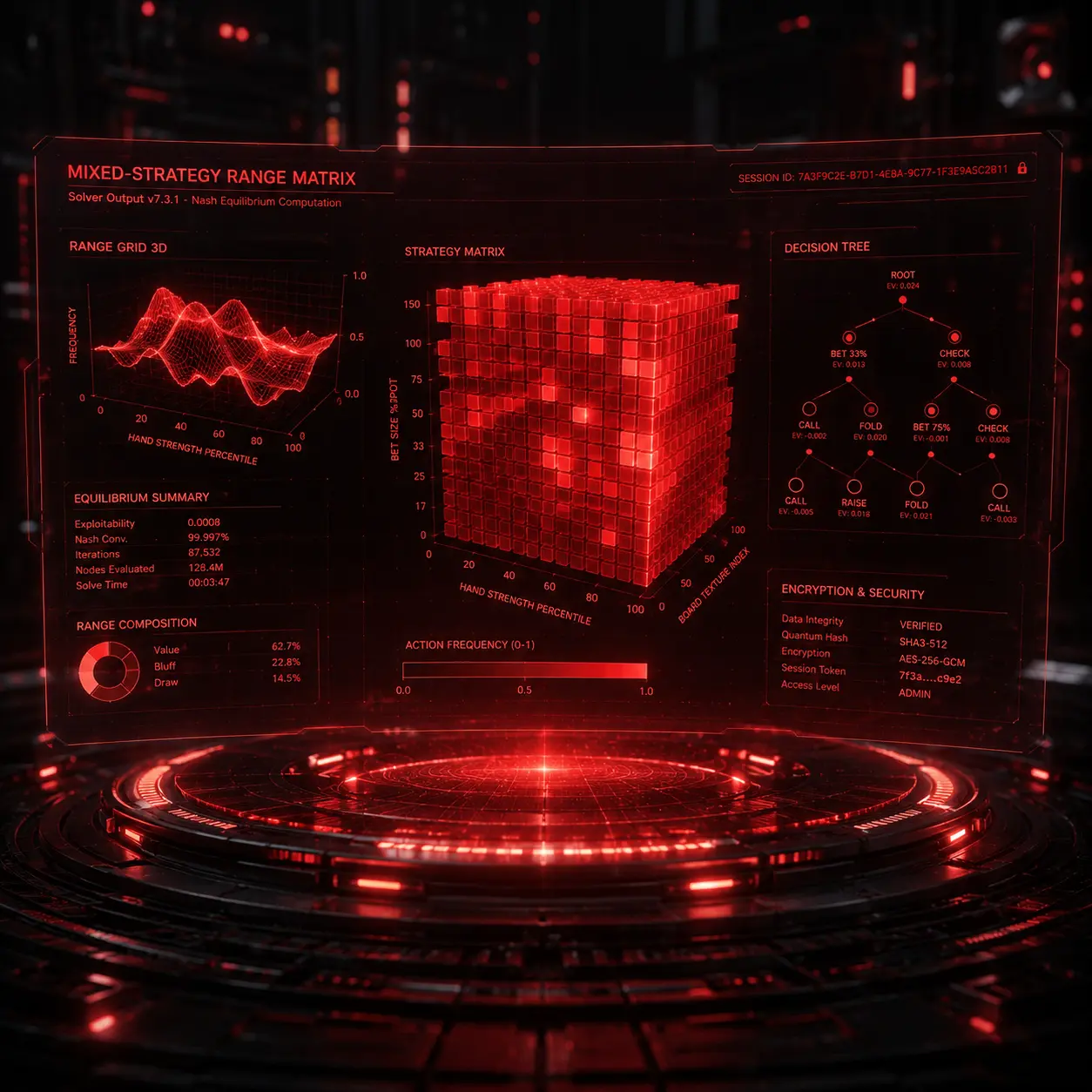
How do you execute perfect postflop frequency balancing across the dynamic board textures of the 7XL tables? The process requires a real-time randomization engine and strict range segmentation. First, you must categorize every flop texture into specific structural profiles: Monotone, Connected, Paired, or Disconnected Dry. Each profile dictates a completely different baseline betting frequency. For instance, on a dry, disconnected board like King-Eight-Deuce rainbow, your strategy should dictate a high-frequency, small-sized C-bet layout (70-80% frequency at 25% pot size) because the opponent’s range cannot structurally defend against wide pressure.
However, on a dynamic, highly connected texture like Jack-Ten-Nine with a flush draw, you must sharply down-shift your betting frequency to 35-40% while increasing your sizing to 75% pot or overbets. To balance this checking range, you must include premium made hands (like top set or Nut straights) alongside your weak air and marginal draws. This prevents the opponent from attacking your check. To execute these mixed strategies without human bias, you must integrate a digital randomizer (a 1-100 RNG generator) directly into your visual grinding matrix. If a specific node requires you to bet a combination 60% of the time and check 40% of the time, look at your randomizer: if the output is 1-60, execute the bet; if it is 61-100, execute the check. This systematic randomization completely sanitizes your play from human tells, converting your tactical execution into a cold, unpredictable algorithmic flow.
Phase 3: Pro Tips – Advanced Equilibrium Safeguards
Maintaining structural neutrality requires absolute precision. Audit your execution using these technical nodes:
- 1. The Range Protection Leak: When you check a wet turn card, do you have enough high-equity combinations in your checking range to prevent automated bluffing attacks?
- 2. Randomizer Synchronization: Are you relying on emotional intuition to mix your plays, or is every single split-frequency action strictly dictated by an external RNG output?
- 3. Sizing Tells Contamination: Does your pot-sizing layout shift based on your actual hand strength, or are your value bets and bluffs perfectly indistinguishable in sizing?
- 4. Dynamic Environment Adaptation: If a weak Level-0 node enters a high-stakes table, do you know how to instantly unbalance your frequencies for maximum extraction without exposing yourself to the sharks?
- 5. The Micro-Node Over-Balancing: Spending critical cognitive energy trying to perfectly balance rare river check-raise scenarios is a waste. Do you prioritize balancing for high-frequency flop and turn nodes?
- 6. The Database Fingerprint: When you analyze your 7XL tracker data after 50,000 hands, does your overall C-bet and fold-to-raise frequency match the clean, balanced profile of an unexploitable machine?
Achieve Absolute Equilibrium on 7XL
Neutralize the competition. Deploy unexploitable mixed-strategy matrices on the world’s premier high-stakes poker infrastructure. Initialize your secure VIP node today.
REGIONAL GATEWAYS: TIER-1 ACCESS NODES
- ▶ UAE High-Stakes Gateway
- ▶ Brazil Institutional Liquidity
- ▶ Pakistan VIP Poker Infrastructure
- ▶ Turkey Crypto Poker Node
- ▶ Israel Tier-1 Access Protocol
- ▶ Global Ecosystem Gateway
TACTICAL INTEL & ADJACENT NODES
Return to Core Command: 7XL Poker Architecture & Core Systems