
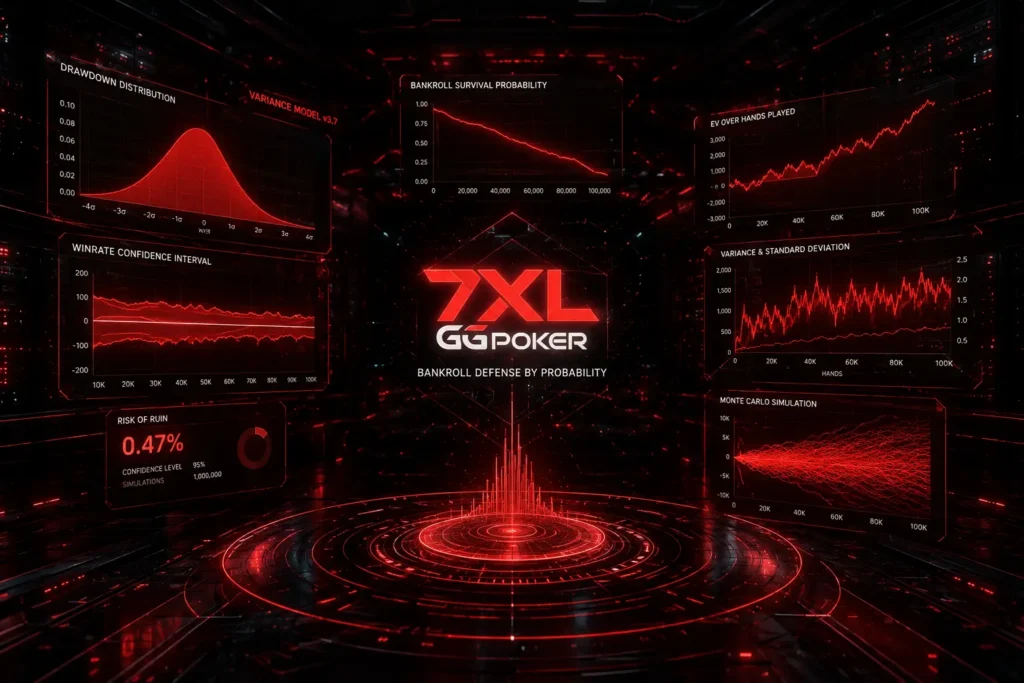
MTT Variance Mathematics: Bankroll Defense in Deep Fields
In the hyper-scalable ecosystem of Multi-Table Tournaments (MTTs) on the 7XL network, Level-0 operators are systematically crushed not by a lack of skill, but by a fundamental misunderstanding of statistical variance. MTTs offer the highest Return on Investment (ROI) ceiling in the poker economy, but they also possess the most brutal downswing architecture. Alpha-Operators do not view variance as “luck.” They model it mathematically. By constructing an impenetrable Bankroll Defense Architecture, Tier-1 players absorb kinetic variance strikes, outlast the mathematical anomalies, and secure massive liquidity extractions in deep fields. This manifesto deconstructs the exact bankroll algorithms required to survive and dominate 7XL tournaments.

Phase 1: The “Whys” – The Anatomy of Deep Field Variance
Why do highly skilled poker players go bankrupt in MTTs? The answer lies in the physics of field size and payout distribution. In a standard cash game, your edge is realized linearly over thousands of hands. In a 7XL tournament with 2,000 entrants, the prize pool is heavily top-heavy, meaning 90% of the field receives zero compensation, and the absolute capital is concentrated in the top 3 spots. This creates massive standard deviation spikes. You can play flawlessly, run deep, and still encounter a mathematically inevitable 50-buy-in downswing simply because of the sheer volume of high-leverage all-in nodes required to reach a final table.
To operate in this environment, you must detach emotionally from short-term telemetry. Variance is a biological filter that removes weak operators from the ecosystem. When a Tier-1 system enters a downswing, it does not tilt; it relies on its pre-calculated Bankroll Management (BRM) parameters. Deep fields (1,000+ players) require an exponentially deeper bankroll than small-field tournaments because your realization of equity (cashing and winning) happens less frequently, even if the absolute EV of each registration is extremely high. Mathematical defense is your only shield against ruin.

Phase 2: The “How-Tos” – Deploying the Tier-1 BRM Algorithm
How do you physically structure your bankroll on the 7XL interface to neutralize the threat of ruin? You must implement the ABI (Average Buy-In) Protocol. Do not look at your total bankroll as a single cash pool; treat it as ammunition units. For standard, mid-sized field MTTs, the absolute minimum Tier-1 requirement is 200 units of your ABI. If your Average Buy-In is $20, your operational capital must never dip below $4,000.
However, when you attack deep-field Sunday majors on 7XL (fields of 3,000+ operators), the math shifts. The variance matrix here requires a 500-buy-in baseline. This means isolating a specific macro-budget dedicated solely to high-variance shots. Furthermore, you must hardcode a strict drop-down protocol. If your bankroll sustains heavy damage and falls below 150 ABI units, your system must automatically force you to lower your stakes. Elite operators do not attempt to “win it back” at higher limits; they mathematically rebuild their foundation at lower nodes until their unit threshold is restored.

Phase 3: Pro Tips – Advanced Risk Mitigation Nodes
Securing your capital requires dynamic adjustments. Audit your tournament matrix with these protocols:
- 1. The Re-Entry Bloat: Are you calculating re-entries into your ABI? Firing 4 bullets into a $50 tournament means you are playing a $200 node, destroying your risk models.
- 2. Late Registration Math: Max-late registering drastically reduces your ROI but also lowers variance (closer to the money). Do you adjust your BRM based on your registration timing?
- 3. Satellite Exposure Limit: Satellites carry immense variance. Never risk more than 5% of your daily session volume on high-variance target nodes without direct buy-in backup.
- 4. The Downswing Mindset: When you hit a 30-buy-in drop, do you start reviewing hand histories to check if it’s variance or a systemic strategy leak?
- 5. Multi-Tabling BRM Stress: Playing 15 tables simultaneously increases the speed at which you hit variance spikes. Does your operational capital match your daily volume velocity?
- 6. Field Size Segmentation: Do you mix 50-man sit-n-gos (low variance) with 5,000-man MTTs (high variance) to artificially smooth out your daily ROI graph?
Deploy Tier-1 Capital Management
Eliminate the threat of ruin. Execute your mathematically proven MTT strategies against massive liquidity pools. Initialize your secure VIP node today.
REGIONAL GATEWAYS: TIER-1 ACCESS NODES
- ▶ UAE High-Stakes Gateway
- ▶ Brazil Institutional Liquidity
- ▶ Pakistan VIP Poker Infrastructure
- ▶ Turkey Crypto Poker Node
- ▶ Israel Tier-1 Access Protocol
- ▶ Global Ecosystem Gateway
TACTICAL INTEL & ADJACENT NODES
Return to Core Command: 7XL Poker Architecture & Core Systems
- ▶ Active Payload: Multi-Tabling Matrix: Scaling Volume without EV Degradation
- ▶ Active Payload: Postflop Frequency Balancing: GTO Neutralization Mechanics
- ▶ Current Node: MTT Variance Mathematics: Bankroll Defense in Deep Fields
- ▶ Next Node: Check-Raising as a Baseline: Disrupting Opponent Equity Realization